
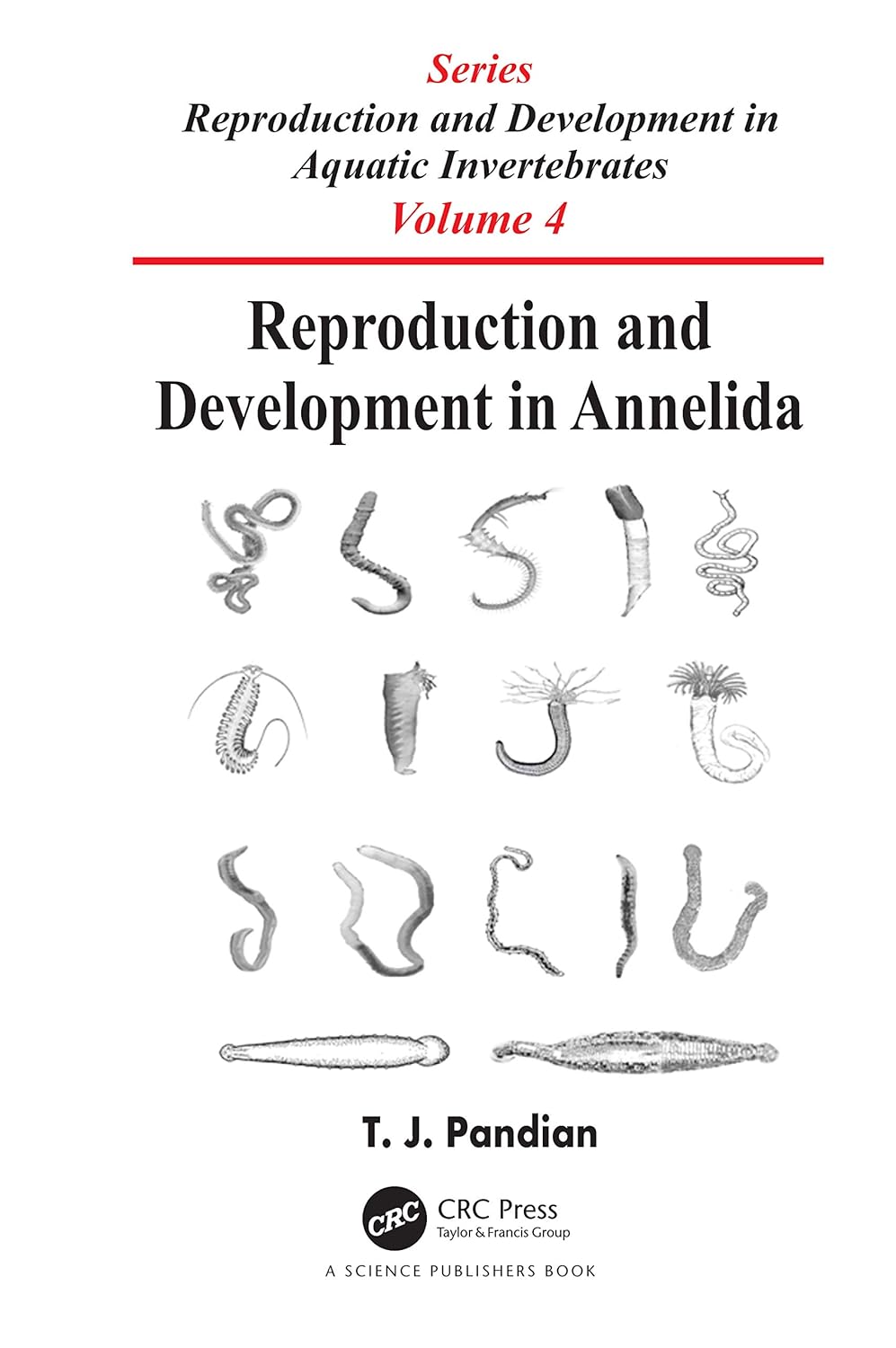
Reproduction and Development in Annelida (Reproduction and Development in Aquatic Invertebrates Book 4)
Product details
| Management number | 231902091 | Release Date | 2026/06/18 | List Price | $19.45 | Model Number | 231902091 | ||
|---|---|---|---|---|---|---|---|---|---|
| Category | |||||||||
This book is a concise informative elucidation of all aspects of reproduction and development in annelids covering from arenicola to tubifex. Annelids flourish between 4,900 m depth to 2,000 m altitude; some of them occur in unusual habitats like hydrothermal vents and subterranean aquatic system (stigobionts). A few have no gut and acquire adequate nutrients through osmotrophism and/or engaging symbiotic microbes. In the absence of exoskeleton to escape predation, the 17,000 speciose annelids have explored bewildering modes of reproduction; not surprisingly, 42–47% of them are brooders. With 13,000 species, polychaetes are gonochores but some 207 species of them are hermaphrodites. Clitellates are all hermaphrodites; of them, 76 species are parthenogens, of which 56 are earthworms.Regenerative potency of annelids ranges from an organ to an entire worm from a single ‘seminal’ segment. The head, tail and both together can be regenerated 21, 42 and 20 times, respectively. However, the potency is limited to ~1% of polychaetes and <2% of oligochaetes. In oligochaetes, the chloragogue temporally separates regeneration and reproduction but sedentary polychaetes undertake them together at the reduced reproductive output. Only 79 polychaete and 111 oligochaete species have the potency for clonal reproduction. Within families, the potency ranges from 2% in spionids to 54% in naidids. Epitoky, a spectacular and unique phenomenon, involves the transformation from benthic to meroplanktonic reproductive morphism. It occurs in 106 errant polychaete species. The larger glycerides, nereidids and eunicids use muscular energy to climb <50 m vertical distance. But the small phyllodocids and cteniodrilids may reduce buoyancy to climb 1,000–4,000 m vertical distance.Heterogamatic sex determination is reported to occur only in six polychaete species, although karyotype is known for 83 annelid species. In temperate polychaetes, a dozen neuroendocrines, arising mostly from the ‘brain’ regulates reproductive cycle. A complete chapter devoted to vermiculture, (i) recognizes the fast-growing candidate species, (ii) distinguishes 'layers' from 'brooders', (iii) indicates that the harvest of oligochaetes may reduce the input of nitrogenous fertilizer in the ricefield, and (iv) explores the scope for increasing wealth from waste. Read more
| ASIN | B08LGNW1ML |
|---|---|
| XRay | Not Enabled |
| ISBN13 | 978-0429582585 |
| Edition | 1st |
| Language | English |
| File size | 10.5 MB |
| Page Flip | Enabled |
| Publisher | CRC Press |
| Word Wise | Not Enabled |
| Print length | 273 pages |
| Accessibility | Learn more |
| Screen Reader | Supported |
| Part of series | Reproduction and Development in Aquatic Invertebrates |
| Publication date | January 30, 2019 |
| Enhanced typesetting | Enabled |
Bestseller ranking
Developmental Biology




Customers who viewed this product also viewed
Geology




Correction of product information
If you notice any omissions or errors in the product information on this page, please use the correction request form below.
Correction Request Form